podcast-natural-laws-of-business
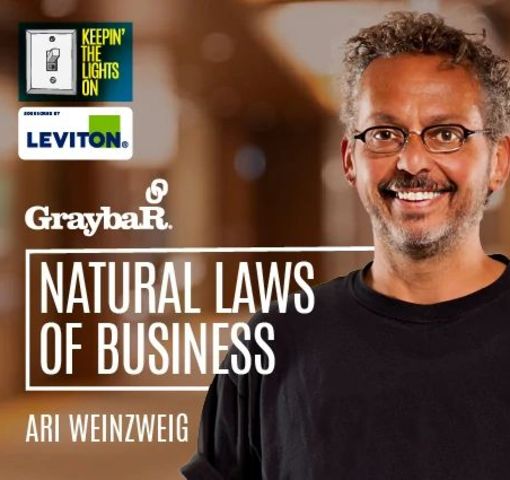
Keepin’ The Lights On

Natural Laws of Business

Guest: Ari Weinzweig
Released: September 23, 2025
listen on apple
listen on spotify
listen on audible
listen on youtube

Show Notes

In this conversation, Ari Weinzweig, co-founder of Zingerman's, discusses his journey from a dishwasher to a successful entrepreneur. He shares the importance of visioning, the Zingerman's Community of Businesses (ZCOB), and the principles that guide their operations, including open book management and continuous improvement. Ari emphasizes the significance of creating a great organizational culture, providing excellent service to staff, and the hard work required to achieve success. The discussion highlights how Zingerman's has built a unique business model that focuses on quality, community, and employee engagement. What can we, in the construction/distribution industries learn from a community of restaurant and food businesses? Tune in and enjoy the ride.

Thank you for listening and please take a moment to subscribe, rate, and review our show on your favorite app.

To get a hold of us here at Keepin’ The Lights On, please email: podcast@graybar.com

Thank you to our sponsor LEVITON

To reach Ari, email: Ari@zingermans.com

Learn more about Zingerman’s Community

Their YouTube Channel

Zingerman’s 12 Natural Laws of Business

More resources from ZingTrain

Click here to learn of the classes they conduct

Small Giants Book, not an affiliate link
Unedited Transcript

TODD (00:01.912)

you

TODD (00:06.286)

For most of my career, I've had a philosophy that the way I want to manage a great company or department is with intention. An intention that focuses on the team, empowering them and making thoughtful decisions with data and the rewarding on the performance of the team. From that, I thought the team could then provide an amazing, consistent experience for the customers, resulting in strong numbers and appropriate growth. Funny enough, this all came from my job in marketing, where I was always looking for that

differentiator of what made us better than the competitors. Here was my thinking, create an amazing culture, attracting and creating amazing talent, creating an amazing customer experience, thus creating an amazing differentiator. I've sought out companies that were running differently and succeeding. And one day I was reading the book Small Giants by Bo Burlingham, and I discovered many cool companies, but one of them was Zingermans, a deli in Ann Arbor, Michigan. What captured me

was their devotion to a distinct mission and vision for staying local. That led me to take a class from them and then interviewing them for a previous podcast that I used to do many years ago. Everyone there blew me away. And after I started this show, I knew the day would eventually come where I would interview some of the people from there. And so we're going to start out with Ari Weinsvig, co-founder of Zingermans. So let's find out.

Who is Ari? And just because it's slightly out of our industry, I want to have Ari describe Zingermans and something called ZCOB.

Cog.

ARI (01:45.28)

Came to Ann Arbor to go to school at the University of Michigan. Studied Russian history and anarchism quite a bit. Graduated, didn't want to move home. I needed a job to facilitate financial independence. I had driven a taxi while I was in school, which was fine, but not that interesting. One of my college roommates was waiting tables in a restaurant in downtown Ann Arbor. So I went and applied, not because I loved food or business. I just needed a job.

I applied for the same serving job he had. They said they'd called, but they didn't. So after a couple of weeks, I went back and I reapplied as a busboy thinking I could get promoted if I did good work, which was...

Seemingly a good plan, but once again, they didn't call after the interview and then I was really running out of money So I went back a third time which we now know is called emotional resilience And I reapplied and I offered to do anything and they offered me a job washing dishes And since I'd never worked in food and do nothing about the restaurant business I didn't know you weren't really supposed to want to wash dishes. So I just said yes sounds great I'll do it and they said can you start tomorrow and I said yes, and I that's how I got

going. So I just lucked out. I'd love to tell you a glamorous story about how from the time I was 10 that I loved food and cooking and my mom was this incredible cook and all our recipes come from her and it's so much more inspiring and glamorous. But the truth is my mother was a good person but not a great cook and I grew up on Kraft macaroni and cheese, Mrs. Paul's fish sticks, Pop Tarts, Tang, American singles, Wonder Bread.

Hawaiian punch and high C. So I had zero culinary background and no one in my family was in business. I didn't even know you could go into business. It wasn't even on the mental menu of things I was considering. Fast forwarding to fall of 1981, after about four years working for that restaurant group, I didn't hate my job, but it was also not super inspiring. It was fine. know, pay was fine. People were fine. But, you know, even though they didn't write a vision the way we do, I could sense where they were headed was not where I wanted to head. I was like,

ARI (03:47.728)

time to do some else. I gave two months notice. November 181 unsure of what would be next and one of those nice stories that actually worked out because most don't. Paul called me like two days later and he's like hey man you know I think you might want to give notice because this building's coming open near the fish market and he had grown up in Detroit where he could get good deli food and in Chicago where I grew up you could get it and you couldn't get it here and we had bounced around the idea off and on over the years of doing something and

Within like a week we decided we would open and four and a half months later we had renovated the whole space, redone the floors, the walls, made the menu, costed the menu, ordered product, made the signs, got it all there and we opened on March 15th, 1982. So we're about 43 and a half years in. The original space was 1300 square feet, 25 sandwiches on the menu, 29 seats, all the old Jewish stuff he and I had both grown up with.

and in our respective homes and then a little bit of what's now called specialty food but back then was mostly just called weird because nobody knew what it was and fast forwarding tonight whatever what year we in 2025. Think so. We'll do about 80 million in sales depending how you count we have about a dozen different businesses all located here in Ann Arbor area within about 15 minutes of where I'm sitting at Zing Train which is our training business right now.

And we have about 700 people who work here and we hire about 400 more at the holidays because we do a lot of mail order now at zingermans.com and we have about 300 staff who own a share in the business as well as whatever 18 managing partners.

Zikov is our act or whatever contraction for Zingerman's community of businesses. It comes out of our... So we opened in 82, fast-forwarding to 1993. So 11 years in business, but one summer morning about this time of day actually, Paul sat me down on the bench out front of the deli when I should have by all rights been inside getting the sandwich line ready for the lunch rush. And he looks at me and he goes, okay in 10 years, what are we doing?

ARI (06:03.534)

And I was like, what? It's like in 10 years, what are we doing? And I'm like, I don't know, man. I got work to do. And he's like, no, this is our work. So when we opened the deli in 1982, so visioning is a huge piece of what we do, as you know, when we opened the deli in 1982, like most people, we did not write one down the way we would now do it for sure. Not because we thought it was a bad idea. We just didn't know you could. But like all,

people or organizations that get to any kind of modicum of greatness, we had a vision in our heads. What he had, I guess, is a very good intuitive sense that we had attained organizational midlife, or what John O'Donoghue, the Irish philosopher, would call a threshold. Everybody listening has been through some. It's where you busted your butt to get somewhere that you sort of self-doubted that you could get to, but then you got there and then you're like, no.

It's not really done, it's just the beginning. His question prompted a year of long walks, long talks, eye rolls, lots of frustration with each other, but continually coming back to the table as we still do now systemically to just keep coming back to the table till you figure it out.

And we did. And during that year of long walks and long talks, we got to know a guy named Stas Kazmirsky. This is all told in the pamphlet that I did called The Story of Visioning at Zingerman's. And Stas taught us this process, which we now call visioning. He had learned it from a guy named Ron Lippett who...

at the Institute of Social Research here at the University in the late 50s, 60s, 70s. And Ron called it preferred futuring and we adapted what we learned from Stas and we called it visioning. But it's basically getting clarity from the heart on the future you want to create. So not a strategic analysis of the marketplace and trying to figure it from the outside in, but more, you know, how do you want to feel when you go to work? How do you want the people who work in your organization to feel? How big do you want to be? Because there's no

ARI (08:08.686)

right answer. What are you known for? What do care about? You know, what's the energy like when you know people engage with your business? And so we wrote our first vision called Zingerman's 2009 which for people who are keeping score at home.

Uh, it was 1994, we went 15 years in the future, not 10. And in there is where we created the ZCob or Zingerman's community of businesses. Uh, so that the vision described that in 2009, rather than doing the typical open more Zingerman's delis all over, we would create this community of businesses, uh, all located here in the Ann Arbor area. have a strong belief about doing business where you live. Uh, each would be a Zingerman's business. So it was one organization, but each would have its own unique special.

So that instead of replicating the deli, we would replicate uniqueness in a paradoxical sense. And that each business would have a managing partner or partners in it who had a real passion for what that business did. So we didn't end up with just, you know, what happens to every, most places they open and then the manager's excited, but then they get a scholarship to go to Australia or whatever and they're gone. And now there's nobody in there that really cares at that deep level that the, you know, passionate founder might've felt.

So, and that we would operate as one organization synergistically, each piece, each element enhancing the others. And we call that the ZCOP.

Welcome to Keeping the Lights On. I'm your host, Todd Reed. And on this podcast, I connect with the owners and pros who design, build, and maintain our electrical, communications, and industrial world to explore the best ways forward. Please take a moment to leave a comment, subscribe, and rate the show, because it helps me know that I'm providing the content that matters most to you, as well as helping attract more listeners like you. This episode is brought to you by Leviton. Now, together with their contractors, integrators, and distributors like Graybar,

TODD (10:03.584)

Leviton builds what's next to light, power, and connect everyday spaces, encompassing electrical, lighting, data networks, and energy management. With a rich history spanning over 115 years, Leviton develops thoughtful solutions that streamline processes, elevate safety standards, increase efficiency, and enhance productivity. Leviton's committed to their people as their innovation, ingenuity, and dedication to safety and quality are fundamental.

to the success of every product they deliver to their customers. Click on the links in the show notes to visit Leviton on graybar.com.

Let's get into the show. If I or one of the listeners were to visit you in Ann Arbor, where might you take us and why would you choose this place?

Well, I'd take you to one of our places. I'd probably take you to all of them. so the deli, you know, is the good starting point. so all the sandwiches, course, corned beef pastrami and all myriad other ones, but it's also, you know, all the artisan cheese and olive oil and, and all that, that we have coffee from our coffee roasting is there bread and pastry from the bake house. we go there. Ms. Kim is our little Korean restaurant, traditional, regional Korean cooking.

It's just up the block. you could go there as well. Amazing food that Ji-Hye Kim, who's the managing partner there and who's from Korea and she's studied her butt off to make the food amazing. And we could go down the road to the Roadhouse, which is all regional American cooking. We do need to get fried ravioli on there. need to remind you about that. But anyway,

ARI (11:45.374)

Everything from fried chicken to barbecue to macaroni and cheese to a lot of fish, a lot of vegetables from local farmers, all that kind of stuff. And then we could keep going around. So we got our bake house, coffee, creamery, Zing train is where I'm sitting now. So for you, I would definitely take you there because you're very interested in leadership work. And then if you were going to get married, we would take you out to corn man farms, which is our 1830s farmhouse and barn that we renovated.

We do events out there. And then I would probably send you for your wedding present on a Zimmerman's food tour to go to Spain or France or Korea or Ireland or something like that.

Okay, that's cool. I didn't know you did that. It's a new thing. That's awesome. Yeah, yeah, yeah. Yeah, it sounds like the perfect day. I'm going to start with the Roadhouse for breakfast and then go to the Deli for lunch and then it's Kim's for dinner. Maybe stop, is Candy Factory still? Go there and get it.

You got it. Yeah, The selection is getting better all the time. I bet.

We're going to talking about how to make sandwiches and do all that stuff. I don't think an electrician is going to be like, well, that's cool, but you know. But we're going to talk about the 12 natural laws of business. And even with that, we're not going to cover all 12. In fact, I'm going to try to, might have to cut some of them out because of time, but we're going to start with law one. And what are the key components of a strategically sound vision?

ARI (12:52.813)

Yeah.

ARI (13:11.564)

Well, we would say it's inspiring and strategically sound.

because strategically sound means in our language that you have a reasonable shot at getting to the vision. So saying, I'm just going to do what I did today, tomorrow is probably strategically sound, but not very inspiring.

conversely saying our organization is perfect, we make gazillions of dollars and everyone's happy and the product gets better every day is a great fantasy but we're not going to make that happen either because there's always problems and some of us aren't happy. So there's a creative tension between inspiring and strategically sound but we have four elements of which as you know those are two that we use to describe what a

Mm.

ARI (14:04.394)

effective vision is the third for us is that it's written down. Again, I know most people don't do this. We didn't do it in 82, but I think it's way more powerful. holds, I mean, for many reasons. If you have staff, it's infinitely easier for them to know where you're going. If you're recruiting, it's way easier for people to tell whether they want to work with you.

If you are like me and every five minutes you have a new idea, that's great, but the vision helps you hold course in the trades context. It's a little like the blueprint for the house.

It may take a few years to get the whole thing built, you know what you're doing. If the owner of the home that you're building wants to pay you to change the blueprint every six months, you can do it. It's more costly and it's not really going to get done in an effective way, but it can be done. And I think the same is true with visioning. Like you can write a vision and change it every year, but

the power is really in declaring to the world where you want to go. And because it's from the heart, it's not like picking something you don't really want, but think you should pick. It's really designing the future of your own choice. for that, those and dozens more reasons, it's very powerful. And I don't say this lightly, but it changed my life. And I probably feel pretty confident saying I wouldn't be here on this call with you, Todd, if we hadn't used it. Because without like the

and I envisioned that you asked about the Zingerman's Community of Businesses stuff that came out of our own hearts and heads after like months of conversation. But no consultant would have come up with that because it didn't exist. So, we wrote the future that we wanted, not pick off a multiple choice menu of five key options that everybody else picks, you know.

ARI (15:59.65)

by creating our own future. I think the buy-in and the energy around it was much higher, just like if you're your own songs or you're making your own art and not painting by numbers off somebody else's. And it's like, well, you could paint by numbers and make more money selling a lot of them cheap. But for me, it's not that inspiring.

And to be clear, Ted, too, for people who don't know, I we write vision for everything. So it's not just the organization, but each business within our organization, within the ZCAP writes a vision, projects start with a vision, people write personal vision. Some of the businesses write shift visions, et cetera. Okay.

So writing a vision has helped you get to where you are today. And there's one thing you talked about when I was there visiting you all at one time. And you're not the only one that said it, but you can have the vision, can have all these great things that Zingermans you have. But it doesn't mean it's easy. No. And it's tough. Let me, so.

Mm-hmm.

ARI (17:06.638)

Everything's hard, which is fine. mean, pick your metaphor. Like no farming is easy. Nobody wins the NBA or WNBA championship and it's easy. Nobody gets to the Olympics and it's easy. You know, nobody raises a kid and it's easy. Like it's all hard. It's just, I wrote a big book on, as you know, on beliefs, not religion, but like what we believe about everything in our lives. so...

People have been led to believe that work shouldn't be hard and then they're frustrated all the time. I look at it like, of course it's hard. How can you do anything great that's not hard? I don't know whether it's, you know, social change or whether it's developing new wiring for an electrical system, but somebody did a lot of work to make it happen. And I embrace that. Like, it's supposed to be hard. The key is not to make it not hard. It's to find work that you want to work hard at. And

Part of the problem is people are working at work they don't really like and then at that point you want it to be easier because you don't even like doing it in the first place. you know if you're LeBron James or Michael Jordan or

I don't know, whatever, Caitlin Clark, and you're playing basketball like you love the game of basketball. Like it's what you want to do. And it doesn't mean you don't take a day off or hang with your family or sleep in once a year. But the point is like you, you love basketball. And so when you do that, you're not trying to make it easier. They're actually trying to make it harder.

They try to get into playoffs. It's harder. They work out more. It's harder. They study more game film. It's harder. But it's harder by their own choice and their own design. And I think that's really the key.

TODD (18:45.743)

So, yeah. So can you share an example of when having that clear vision, it was tough to have that vision and it made a significant difference in like even just day to day work?

Yeah, I mean, I well, I think it does every day because once you have it, it allows you to say no to things that don't fit the vision without a lot of aggravation. So following my metaphor, if the if the vision is the blueprint for your dream home and, know, whatever you're building mid-century modern.

style and somebody comes with a great plan, you know, to build gothic and there's a government subsidy for gothic design. don't know, you know, like it's sort of like, well, no, I'm not doing that because we're 30 % of the way in and I love mid-century modern and that's how we started, you know, and it's the same here. So when people call and they want us to open in St. Louis or San Francisco, it's a five-minute conversation. You know, we don't need to study it. We already decided that we're not doing that. When we

you know, whatever it is. mean, like we have a whole section of our 2032 vision that's a whole new thing for us, which is working with young people. So not about hiring 17 year olds, which we've always done and still do and have some amazing teenagers working with us. But this is more about teaching our

our content like what I'm sharing with you today, you know, with eight-year-olds, nine-year-olds, 10-year-olds, 11-year-olds. And right now, actually 50 feet behind me is day four of a summer camp that Zing Train, our training business at Bake, which is our home baking school, have collaborated on. I think it's the second year where they got, I don't know, 30, whatever they are, 12, 13-year-olds or something in this summer camp for a week.

ARI (20:30.362)

they bake in the afternoon and they learn, you know, energy and leadership and appreciation in the morning. it's awesome, right? So that came out of that vision. Like, and it doesn't mean it could never have just spontaneously happened, but by writing the vision and describing we're going to do this, then everybody in the organization knows we've committed to doing that. And then they all can start thinking of how they're going to do it.

Hey, a quick word from our sponsor, Leviton. One idea back in 1906 powered and connected the way for many igniting years of innovation and adaption for Leviton. And it all began with a single gas mantle tip. As industries have evolved, Leviton has been with you every step of the way. Together, they make it happen by addressing hot topics, anticipating changing market dynamics, and meeting stringent industry regulations.

Rising to the challenge, Leviton's team has grown to include a global reach so they can support you no matter where you are. For now and into the future, Leviton will continue to listen, collaborate and participate with industry stakeholders and then manufacture innovative controls, lighting, electrical and network solutions that are going to meet the changing needs of the built environment. The result, each product Leviton brings to market will be designed to seamlessly integrate into your daily life. At Leviton, they like to say, we make it happen.

Let's talk about law three. Without good finances, you fail. Now this is a no-brainer. It seems like a no-brainer, but, and I don't think most business owners violate this on purpose, but you know, I see, I've been a part of, and I see companies all the time shutter for poor finances. So how do you see owners violating this law?

Fail.

ARI (22:21.182)

Well, mean, it's a, it's hard to make it work back to it's hard. you know, we, we read constant stories about people flipping their companies for gazillions of dollars. And so we start to assume that that belief is, or that, that reality is, is a common reality, but I would suggest it's a not common reality. and that for 99 % of us in a good way, it's work your butt off and try to make sure there's a little more at the bottom line than there was, you know,

the year before. In our industry, it's never easy. You know, the profit margin in food is very small, even when it's good. I'm not complaining. That's what we embrace. We're not in high tech where I, you know, supposedly people run these giant numbers. You know, here every cup of coffee matters.

And every little bit matters, you know, so we're always working on that. How have you seen people fail? Well, sometimes the business model doesn't work. I mean, it's not like they designed it that way, but sometimes they're just not, you know, they're not getting enough business. Sometimes they're not doing the work to take care of customers in an amazing way so that people keep coming back and choose you when they could instead choose one of the 25 other places that are doing something comparable.

Other things that can happen. They don't price properly. People make up prices mostly based on what their competition is charging, which if the competition is charging the wrong price and you copy them. Now you're charging the wrong price. If you're giving amazing service experience, you probably need to charge more people often under charge. Then they're stressed and can't get things, their bills paid. it's like I would.

I mean, just sat in one of our meetings advocating again, the same thing like charge more, invest more into making the service experience amazing, differentiate yourself, blow people away. It's not going to be for everybody, but it's way more fun and it's more fun for the client. So those are all reasons. Also people don't do good. They don't keep their books effectively if it's a small business. So if you're not doing cashflow projections, you're not keeping a P and L.

ARI (24:36.366)

It's a little like playing basketball all year and hoping that the numbers work out at the end.

Don't recommend that. Uh, and then one tactical thing that we do, I don't know how many people listening have staff, we're open book management. So that means that we share the numbers with everybody and then that we want them, if we can get them to, to participate in helping run the business. And they need to see the numbers for that. So when the sales are good, people know when the sales are bad, people know when the profits good, they know, and they get something when the profits bad, they know. And so, uh, you know, if you're on a basketball team and your team's

Losing by 20, it's a bad feeling, but the hope is you're then motivated to play harder or more effectively in the next game, you know, and oftentimes the solutions to the problems. Sure, the owner might have insight, but so too to the other people and most systems are not designed to help make that happen.

Okay. Let's touch on open book management really quick. I know it's a huge topic, but

But because it comes from Missouri.

TODD (25:38.296)

That's right, Springfield. It's a great, need to talk to, it's funny, I was just thinking about that, I need to talk to that group down there. okay. In St. Louis or are they holding?

Yeah, I'm keynoting at their conference in September. No, they do it in Dallas now.

that's right. moved that. Well, can you touch on just briefly? Yeah. What? How? How do you define open book management for Z Cobb and kind of like, do you?

Well, we adapted it from them. So I give them credit for teaching us. And then we've again adapted like we did the visioning to make our own version, our own. I mean, basically that's what I said. It's about involving as many, anybody who's interested in helping to run the business. In order to run the business, they need some numbers. So what OpenBook is not is the accountant comes to a meeting and reads the profit and loss statement to the employees who roll their eyes, fall asleep and spend the whole time on their phone scrolling. This is where they're participating in running.

the business in order to do that they need to know the key metrics and every industry and even within our own organization has different metrics because what works in electrical might be irrelevant in

ARI (26:48.65)

in baking, you know, but the point is it's not reading the whole P &L. It's 10, 15 metrics. I like to describe it as like, if you were at a basketball game and you went to the bathroom and came back, what are the key numbers you need to know when you get back? Like you don't need to know the point guards shooting percentage, three point shots when.

You know, whatever, under two minutes to play. Like you might be curious and you could look it up, but when you come back from the bathroom, you mostly want to know the score, how much time is left, key files, you know, and that's what would be on your scoreboard, 10 or 15 items. And then we share responsibility for those through the business. So different people in quotes own different lines and their responsibility is to report on the line, the content.

to forecast what's coming and forecast as a leadership act. So not a prediction, but where you're committing to getting to. And then they're responsible for delivering on the results. So it could be in our work that a server owns the line for check average at the Roadhouse.

Well, that person is also responsible for getting their peer group to like do better to hit the goals. So it doesn't mean they're responsible alone. We're all responsible, but they become the leader. So you're spreading leadership, you're spreading power, you're spreading information. You're bringing in more information from across the organization. It's a really great system.

I don't think the old system actually makes any sense because they've been saying basketball over and over. It's a little like you're playing basketball, but only the coach knows the score. The team just get called, yell that to play harder all the time. But after a while that gets a little old. This is where they know the score and they may not like the score, but at least they're aware of what's going on because what's happening is.

ARI (28:32.054)

You and me and most people listening to this are in the back room stressing out about how we're going to pay the bills. Meanwhile, the staff is convinced you have so much money that you don't know what to do with it. And so that disparity or incongruity of information is causing enormous stress, you know, in an unhealthy way. Like what's appropriate is everybody's stressed because we're losing. Not the coach is stressed because they're losing and the players are stressed because they think they're winning.

but the coach is acting like they're losing.

Yeah. Yeah. And what's interesting is nowadays you hear more and more of the athletes themselves are learning how to, what stats to look at themselves and data diving. And so I can understand when I'm playing Ari, I know how he moves and what, know, so I can defend or shoot or whatever. Money ball type of stuff. Yeah. I that whole thing. I love the line ownership of, and we buy a line, I a line in the financials, not the line cook, although it does, it's important too.

ball.

ARI (29:32.334)

That's important too. And just to be clear, we measure on three bottom lines here. So great food, great service, and great finance. So different businesses will have different metrics. And there's often things, like I mentioned, check average in the restaurant. It's not on a profit and loss statement anywhere, but it's a key metric. So there might be metrics that are critical to the effectiveness of our work, but they're not on any financial statements.

This isn't in lieu of the financial statements, but those are like sort of the detailed historical records that you and your accounting or bookkeeper want to have. They're really important, but this is more the scorecard for the people who are out on the field or the court every day playing the game.

Well, they're, they're key numbers that drive the bottom line number. Like I remember reading the story about that. In the book where I discovered you all small giants a billion years ago, there was a theater and the butts in the seats were the key number there. It's like, I mean, if you have 10 people or what, it's not, that's not huge, but it impacts the bottom line anyway. Law four, people do their best work when they're part of a great organization. So

Yeah.

I don't know, what are a couple key characteristics that make an organization great to work for?

ARI (30:50.786)

Well, I mean, I think everybody can define for themselves, but, know, again, it's convenient to use sports, but I mean, if you're on a losing team, it's hard to, you know, like in the beginning, you might still come in early and stay late to work out. But if no one else is doing it and you're going to lose anyway, after a while, it just becomes hard to hold that motivation. Conversely, when you're on a team where everybody's trying to do great work, whether it's an electrical or food or basketball or poetry, doesn't matter. Like you're, you know, it's inspiring to like.

Like if you're doing great, I want to do great. Like who wants, nobody wants to, you know, not fit in. And so in a healthy organizational culture where people care, where dignity matters, where humility matters, those are the things we're reinforcing. And what I would suggest is an unhealthy culture. It's like super competitive. People are hurt.

badly because others are trying to destroy them or beat them down in the belief that it's building themselves up. Or there's apathy is widely spread so people really don't care. You know all of which in quotes seems to your earlier question like less work but it's actually exhausting. Whereas the people who are working their butts off at something they believe in, yeah it's hard but it's fun and they want to do it.

And when you're around other people who are like that, you want to do well too.

TODD (32:17.294)

Can you share something that you've changed over the years that significantly improved just to use the term that people use a lot to define this and engage the employees more? It's not really what we're talking about, but it ties to that.

Yeah, I mean, I think all these things do. So OpenBook, a big thing is that we, in addition to OpenBook, is that, I don't know, 25 years ago now, just sort of mostly, to be honest, accident, we sort of made all our meetings open. So I say all in quotes because there's certainly, you know, private HR meetings or whatever. the point is that we default to opening them, not to closing them.

And so, yes, there's meetings that are closed, but it's because somebody sat there and was like, you know, really, we need this to be in private because it's got to be confidential, as opposed to most settings where they're all closed and less once in a while you have an open one. And you might say, what's the difference? And I'm going to tell you, it's the same as what we talked about with the finance.

We don't know what we're doing. Like, like maybe people listening already know, but I don't know what I'm doing and I'm trying to figure it out. And most people that I've talked to in my decades of doing this, they're all just trying to figure it out. And so there's a lot of wisdom that diversity dictates will be present in the staff. Like not everybody will have a great idea, but my ideas aren't always great either. know, and so, so getting a few more voices in the room and can help. then similarly,

when they're locked out of the room, they're spending a lot of time making up these super creative, but totally inaccurate stories about what you're doing in the room they're locked out of. And it's like, okay, dude, come on. And so instead of complaining, it's like, show up. Well, I'm busy. Well, then don't complain. But it's essentially calling people's bluff in a healthy, positive way, which is to just say, okay, come on in the room, let's go. And I think that's really helped quite a bit.

TODD (33:57.39)

you

TODD (34:18.926)

Okay.

And to be clear, most people don't go, but I think there's a big difference between choosing not to go and being prohibited from going.

Yep. Law five. If you want the staff to give great service to customers, the leaders have to give great service to the staff. Can you give a couple of practical examples of how you

Well, it's fairly straightforward more than most people would like it to be it's not metaphorical it's real When I come to work like I am now, I just look at the people who work here like my customers and You know to be clear there's customers I've been waiting on for 30 40 years So it's not like I act like the butler when they come in I might tease them or curse with them or make fun of their shirt or you know have fun, but

I need to always remember that if they start complaining, I got to get back. I can't act like it's my cousin. I need to act like it's a customer. so, you know, I know people mostly won't believe it, but I'm a total shy, awkward introvert. It's just, I learned this because it got hard to lead a large organization without talking to anybody. But

ARI (35:26.222)

You know, the reality is when I see new employee, I would prefer that they don't see me and I don't have to talk to them. Like it's far less stressful. But then I remind myself, like, if I don't greet them, I'm not giving them good service. Just like if I ignored a customer, I would be giving them bad service. So I need to just do what I try to do. Take a deep breath, walk over, stick my hand out and say, hi, I'm Ari. Which for the extroverts is like, well, what's the big deal? But the introverts listening will be like, no, I get it. And so.

You know, all day long that's happening. then similarly, however, whatever process or recipe or framework you have. And if you don't have one, I recommend you get one. And Zingerman's guide to giving great service book has ours, but some format for dealing with guest client complaints. Right. And so that's what we teach with customers. Well, I need to use that with the staff too.

business. Law seven successful businesses do the things the others know they should do, but generally don't. Yeah, example of something that Zingerman's done that perhaps your competitors didn't

Yeah.

ARI (36:27.182)

Well, there's millions of them. I mean, that's our whole story. So, it's just constantly improving the product, you know, is one. Like, so we make, you know, everybody knows if you get a lot of complaints to improve it, right? But there's a whole other side of improvement which is nobody complained. But you're improving it anyway. Because you know it can be better and that's what you're driven to do and then you're willing to charge more because you made it better. And that's just one example but

But yeah, mean that the bake house starting to mill grains in-house. It's not like anybody asked us to do it. It's just, but it definitely has increased the quality of the bread and pastry. The Roadhouse just upgraded the butter into biscuits, which are already one of the best sellers and are delicious. And you could have them when you come for breakfast. And now we're making them with the Vermont Creamery Cultured Butter, which is

remarkably good butter and made them even better still. know, so they were already really great. People weren't complaining, but we just took a step to add, you know, to upgrade an ingredient, which makes a meaningful difference. So it's all of that. It's going back to the customer table one more time. It's calling a catering client two weeks before the event to just say, Hey, I'm just thinking about you anything you need before we get to the actual event. you know, from a leadership standpoint, it's reading more books. It's listening to podcasts. It's having awkward conversations.

conversations, you know, I mean, it's just life is filled with all these things and if you know, I I'm not judging but there's places that people you know, we all choose to spend our time where we choose to spend our time and it's a free choice, right? And so like when I spoke, I spoke at a class on campus a couple years ago and you know, I was like, well if you spent two hours less on social media every day

That would be 700 hours at the end of the year. In 10 years, it's 7,000 hours that you could have invested in reading books and learning new skills instead of scrolling Facebook. And I'm not saying it's bad. It's just deciding where you want to put your time. Just like when you're going out to eat, you could decide you want a really delicious, healthful meal, or you could decide you're going, you know, like I grew up going to fast food. It's not inherently evil, but the impact in the long run is huge. And.

ARI (38:49.6)

Sandford whose work I really love passed away in December in her 80s but she would know calls a lot of this is indirect work so most of us have been raised to like focus on direct work like wear blue shirts sales will go up 9 % you know but there's the other part of the work which is indirect which is teach people about dignity

And then over time, it changes the way they feel about themselves. It changes the way they deal with their coworkers. It changes the way they deal with guests. It changes the way they deal with their families so they feel better at home. But there's no thing like you teach dignity and employee engagement increases 4.8 % in first three weeks.

Yeah, yeah, I think that that's an important thing for people listening. If you're going to do any of this kind of stuff, it often takes a long time.

In fact, that's a natural law.

It's one we're not gonna cover, but there you go. We got a free one there. I guess I'm curious on like the butter example. Let's just go to that one for a second. Because here was gonna be my question. I was gonna ask when I wrote it down, you know, before we met, how do you discover one of these things and then implement? because you said someone complains, okay, now we need to look into something. Right. Well, I'm guessing no one complains.

TODD (40:13.26)

necessarily about the biscuit. how did that how do you even discover these things that people aren't doing like what and you kind of mentioned it kind of with the dignity.

our is just to keep learning. So if you're doing natural law number seven, you're doing all these little extra things, then you're reading about food, you're studying other menus, you're thinking about it, you're reflecting on it, you're, you know, to your point about vision, it's also about values. our, in our guiding principles, one of them is about food, of course, and

in that we define what quality means to us. It's not that others need to use our definition, but it means full flavor in traditional food. So if you can make the food more full flavored and you can go back to more traditional stuff, those generally are going to help us go in a more interesting direction. So 150 years ago, most butter was cultured.

It means that you leave the cream out overnight to ripen like yogurt or cheese. And now hardly anybody does, but we work with Vermont Creamery and in the Websterville, Vermont, and they're making great butter. And so if we want, it's way more flavorful, it's higher butter fat. So if we want more flavorful biscuits in this case, or also it's in the butterscotch pudding and it's in the grits and it's in the mashed potatoes now, and it goes out with the bread from the bake house when we serve that.

But.

ARI (41:37.942)

Like you got to go to the better product. It just tastes better. It's more traditional. The only reason cultured butter went away is because technology allowed people through refrigeration and cream separators to avoid the step, skip the step of letting the cream naturally rise to the top. Right? Everybody knows that saying, but nobody knows what it means, but it actually does rise to the top. so the cultured butter tastes better, better flavor, more traditional.

supporting a local in their own community vendor who's working with local Vermont farms. When you come in to eat, you're going to open that biscuit and you're going to smell it and it's going to be like, Whoa. And then you're going to taste it and it's great. And then we serve it with more of that butter. And when you go somewhere else and get a biscuit, this is strategic too, because when you go somewhere else and get a biscuit, it's going to seem, it would have seemed fine. Except now you ate this one and you're going to go, yeah.

It's not as good.

How does Zingerman's approach to continuous improvement really impact your operations? You've touched on it in seven, so now I'm kind of curious. How are seven and

Well, seven, seven fed into it, but you could do the little extra things that don't necessarily make you continuous improvement. like calling a customer to check on their order is awesome service, but I wouldn't say it's improvement. It's just, reading a book, but not doing anything with it is doing a little extra thing, but you haven't converted it into something. So, the, the continuous improvement is just.

TODD (43:04.28)

Okay.

ARI (43:16.91)

the obvious, like what I knew last year is now less valuable because there's a lot more to have been learned and other people have learned stuff. You know, people's nostalgic memories of the deli in 1982 lead them to say stuff like the sandwiches were so good, it's never been the same. But I know it's just not true. We've upgraded the quality of every ingredient, I think, other than one on that sandwich. And so

It's a better sandwich by far 40 years later. And that didn't come from customer complaint, although it could have, it just came from us going, well, let's find a better quality sauerkraut that's naturally fermented. Let's open a bakery where we can bake bread that's more flavorful, more traditional rye bread. Let's.

you know, et cetera, et cetera. So I mean, it's just, always pushing ourselves to get better. So that's self-improvement as a leader, but it's also product or service quality.

Yeah, I guess I kind of, when I think of continuous improvement, maybe because it's in my world more, I think about the operations of the business, how you're actually getting the standard.

Well do that too. And we use a lot of lean. And I was just sitting thinking about that. But we do that also. That's a system that's designed for systems improvement.

TODD (44:39.884)

Yeah, and you have a book or a pamphlet on that, I believe.

I don't but Tom Root is one of the partners at MailOrder, teaches lean all over the place and he has a booklet that he co-wrote on that. I have one on our bottom line change process.

Okay.

TODD (44:56.854)

That's what I'm thinking of.

which is our organizational change recipe, which is not opposed to lean, but it's not about lean per se. It's about our recipe, which involves as many people as possible in the interest of bringing more diverse voices into the conversation before you decide instead of the old model, which is where you tell them at the end and everybody freaks out.

So yeah, and it can kind of tie into that because maybe that result of that continuous improvement process means something that's going to have to change and so it can tie into that. Okay, that's what I was thinking about. All right, Ari, we're to our last question. mean, we could spend a lot of time, but one last one here. So I always like to close it out by refocusing on the why of what we do. So what motivates you to do this day in and day out? What keeps you excited and passionate about what

I love it.

ARI (45:47.15)

Well, everybody's different. So people are motivated by different things. For me, impacting people's lives positively, learning, having fun, making a difference, doing cool work, making something special that nobody else is doing. All of those and more are awesome. And the impact on people's lives comes everywhere from like the way we serve them at the counter to bringing, you know,

Like the other night at the Roadhouse, there was a little kid who had, I don't know, played soccer or whatever. And he was there with his mother and his grandmother. Right. So the, I don't know, I said that was walking by the table, pouring my poor water every night. It's sort of my re grounding into reality. So anyway, they were looking at the menu and I said, you know, can I answer any questions? And his mother goes, yeah, help me figure out how to get them to eat some protein and order something besides. I said, and I asked him what he could do. And he goes,

let my mother tell my mother to let me order buttered noodles. And I was like, okay. And she goes, well, he's been playing sports all day and he needs protein. And I was like, well, why don't you get some protein on top of your buttered noodles? Like, what do you like? We could put chicken on there, steak, fish, you know, she goes, well, he loves shrimp. I'm like, awesome. We got these wild caught shrimp from the North Carolina coast and dude with that cultured butter that I just talked about.

Mancini pasta which is the only farmstead pasta maker in Italy on the east coast in the Marcais so they grow the heirloom wheat and make the pasta in your world be interested in the bronze dye extrusion that makes the really rough sandpaper like surface that you want. I'm like that's a world-class meal and you're 10 years old. So wild-caught shrimp cultured butter from Vermont and farmstead pasta from the east coast of Italy. I'm like dude I would eat that. He's like you said dude. I'm like yeah whatever. He goes

This is odd, you know, so like, and then he loved it. So the mother's happy. He ate protein. He's happy. He had this, you know, 10 years old and he had this world-class meal and better shrimp than he's going to get anywhere else around. Everybody wins. And it's a business thing too, because where's he going to get that? Nowhere. So that means a 10 year old is probably a lifetime customer now.

TODD (48:03.086)

Nice. Love it. Ari, I just get energized every time I talk to you and I've watched a few videos. You're in a million things now. And Zingermans has their own YouTube channel, which I'm going to link to, which is pretty cool. So thank you so much for this. I'll look you up. Appreciate your time. Yeah.

And you'll put the link to the books and to the news also. And you're welcome to put my email with people on it.

Yeah, that was my conversation with Ari Winesweg, co-founder of Zingermans. You can connect with Ari and see what's happening over at Zingermans by heading to the links in the show notes. Hey, I would love to hear an unusual place where you've been inspired and then made changes to how you run your organization. Send me an email at podcast at graybar.com or leave a comment on YouTube or Spotify. If you enjoyed this episode, you can help us grow this show by subscribing and leaving a five-star rating in your favorite podcast player or YouTube.

Thanks for listening to this episode of Keeping the Lights On. We'll see you next time.