podcast-the-power-of-intentional-energetic-presence-with-anese-cavanaugh
Keepin’ The Lights On

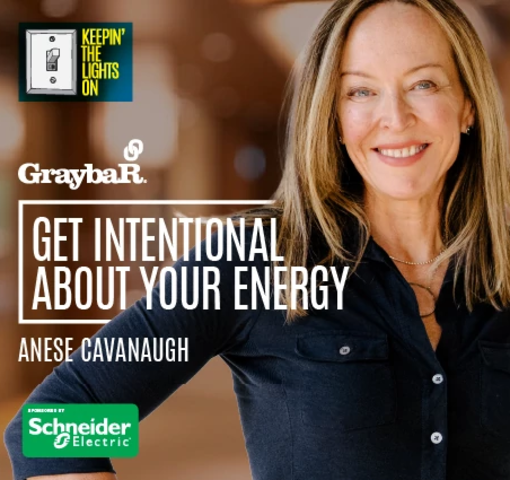
The Power of Intentional Energetic Presence with Anese Cavanaugh

Guest: Anese Cavanaugh
Released: July 8, 2025
listen on apple
listen on spotify
listen on audible
listen on youtube

Show Notes

In this conversation, Anese Cavanaugh discusses the significance of personal energy in the workplace and introduces her methodology, Intentional Energetic Presence (IEP). She emphasizes how the energy individuals bring can influence team dynamics, leadership effectiveness, and overall workplace culture. Anise shares practical steps for enhancing energy and accountability, highlighting the importance of self-care and awareness in fostering a positive work environment.

Thank you for listening and please take a moment to subscribe, rate, and review our show on your favorite app.

To get a hold of us here at Keepin’ The Lights On, please email: podcast@graybar.com

Thank you to our sponsor Schneider Electric.Learn more about Anese and IEPReach Anese on LinkedInOverview of IEP MethodThe impact of IEP in a meetingSelf-Study courseThe five steps: Hey Todd!

Unedited Transcript

Todd (00:03)

Most of you listeners viewers all work with energy of some kind from either from low to medium to high voltage And we all understand the important of clean consistent energy It's in everything that we do from the manufacturers that we work with to in distribution to the building and maintenance and engineers and of course all the installers contractors electricians that install and maintain our infrastructure but but what about the personal energy that we

you bring to the teams to our day-to-day interaction. Have you ever had a team member that seems to drain the energy out of the entire room? What if there is a way you could help shift that energy in the room to help create a successful and productive meeting, for example? What if that shift in energy could impact the entire organization to propel it beyond expectations? Well, when talking about energy in the workplace, I couldn't think of a better person to talk with than Anise Kavanaugh.

CEO of ActiveChoices Inc, creator of the IEP method, which stands for intentional energetic presence, and the Positive Energy Workplace Initiative. I could go on and on about Anise, but let me pass the mic over to her and say, Anise, who is Anise Kavanaugh?

Anese (01:17)

I'm someone who's devoted to helping people show up in the world. That's it. I'm devoted to, I'm an author and a speaker and a CEO and a mom and a dog mom and just a human being who is just incredibly devoted to helping people, individuals, leaders and organizations show up better in the world.

Todd (01:38)

Hey, real quick, if you can all do me a huge favor and subscribe to the show via whatever platform you listen to it, rate it with a thumbs up or five stars or however they work it on your platform. Maybe even comment on each show. All that helps our robot overlords and the algorithms help people find the show and help bring new people, new guests, new listeners to the show to grow our community. Welcome to Keeping the Lights On.

I'm your host, Todd Reed, and on this podcast, I connect with the owners and pros who design, build, and maintain our electrical, industrial, and communications world to explore the best ways forward.

At Graybar, we know electrical contractors are under more pressure than ever. Tight deadlines, labor shortages, and long lead times make it harder to get projects done on time and on budget. We're excited to offer a more innovative solution, Flexset by Schneider Electric. Assembled right here at Graybar, working with your deadlines, we can assemble and deliver a fully configured switchboard outperforming the traditional lead times of 20 to 40 weeks. You also get

built-in digital tools, simplified installation, and UL891 compliance, all backed by Schneider's 100 plus years of power distribution expertise. Flexset is fast, flexible, and built for how you work today. Talk to your Graybar rep to learn how Flexset can help you stay ahead of schedule and keep your projects moving. Click on the link in the show notes to go learn more about Flexset on graybar.com.

Let's get into the show. So, you know, I like to start out each episode with the meals that bring us together. So Anis, if I or listeners are to visit you in your hometown, where might you take us and why would you choose this place?

Anese (03:21)

Hmm. Well, I'm going to give you two options. One, there's a really good little food place that we like to take our people to and order from, which is called T-Bar. It's just very simple, very clean, just easy, clean food. So we do that. I just had a client fly in last week and that's what we brought in. Or I might, depending on the mood and what we're up to, I might actually do a little bit of food prep and I might bring along a cooler Todd that would have.

a really, really clean meal for you and one for me. And it would probably have something like a good protein and a really good carb and some good vegetables, maybe a little bit of fruit, some oil, a lot of oil, good oils. And we would probably eat my food prepped meal. We'd probably eat that because I would know that whatever I put into it, I put a lot of love into it and I made sure the ingredients were really good and I would make sure that it was going to be something that was going to fuel us both so we could have the best.

conversation possible. And I'm more likely to do that than take you to a restaurant.

Todd (04:24)

Okay, little intentional home cooking then. what I'm hearing. Do you have a favorite food item that you particularly would like to have or share?

Anese (04:28)

Thanks.

Yeah, my favorite meal is, ⁓ it's my go-to all the time. It's chicken breast, butternut squash, micro greens, jalapenos, blueberries, and some olive oil.

Todd (04:48)

You know, our primary listener base are contractors, electrical contractors, low-com data contractors primarily, ⁓ and their technicians and the electricians that do the work. And so I hear about challenges that they're all facing, like, because I'm talking to them at their shows and, you know, talking to our customers about what's going on. And ⁓ I just want to kind of go through kind of some of the challenges that I hear about, and I'm going see if they relate to what you hear about too. ⁓ So contractors themselves who run their businesses.

Talk about challenges with margins getting tighter, cash flow and insurance, of course, and then securing appropriate bonding. Both the contractors and the electrician's technicians talk about labor relations or employee employer manager. That's probably any company. But also they start to talk really a lot about the struggle to find, train and retain the right people. Because the like many industries, they're facing a major transition from

generations to one generation to the next, a of retirees, a lot of people moving out. And this transition is seeing job sites with fewer people and also less experienced new people, which contributes to safety and mental health concerns for all involved. And lastly, there are a couple of hurdles to culture change, such as internal bureaucracies and also traditional ways of doing the work of construction.

And these hurdles are making it tough, it seems, to create a successful feedback loop that brings about meaningful change and improvement to construction broadly. Curious if any of these challenges align with what you're seeing as top challenges facing your clients.

Anese (06:31)

Yeah, well, there's so much to unpack. Just to give you a little bit, I'm going to give a little bit of context and I'll dig into the question. But a little bit of context, as you asked me earlier in my 30-second speech, who am I? The thing I didn't mention is that I created the IEP methodology, which stands for Intentional Energetic Presence. And the reason why I created that methodology is because what we saw with leaders and companies that were dealing with so many different things, a lot of what you just mentioned, they were

addressing the doing and the problems and the feedback and culture. They were addressing the doing and all the things that they had problems with that they were being challenged by. But what they weren't addressing was the being and the intentions, energy and presence they showed up with to deal with those problems. So just want to give a little bit of context there is everything you just talked about has to do with the doing of leadership, the doing of leading a business, the doing of insurance, the doing of tight margins, et cetera, et cetera.

The IP methodology really addresses how the human being shows up to address all those things, which if we're in command of how we're showing up and we're really taking care of ourselves and we're managing our intentions and energy and presence, then everything you just mentioned gets a little bit easier to handle. I actually started my career in health and productivity. You know, I started actually working with athletes, but then I worked into work. I moved into working with in corporate America in a very large oil company.

And I worked in health and productivity. And part of our job was to actually to go out and work with people on the rigs drilling oil and at the different refineries and whatnot. And a lot of it was around OSHA and health and safety and working with electric, like all the different things that you're talking about. And looking back at that job, you know, when I worked with that company, a lot of stuff we were dealing with was what you just mentioned. But the big thing I remember was working with safety.

And, you know, when I think about electricians, I think about contracts, I think about all the lists that you just named. That safety piece was the piece where actually I wish I would have been, I wish I would have created the IP methodology then, right? Cause I hadn't created it yet, but the safety piece when there people would go out on rigs or they were out at the refineries and whatnot. If they didn't have their intentions, energy and presence lined up, then it put them actually more at risk to, for more injury. So I started an injury in

illness prevention, doing a lot of stuff with OSHA. And I actually didn't think about this until you and I had done the pre-call afterwards. I was like, I forget. I forget about that part of my life all the time, but it very much applies to what we're talking about with the people that are watching this show right now is that your IEP and how you're showing up and how you're taking care of yourself and how you manage your energy not only is impacting your ability to create more safety when you're out there doing your work for yourself and for others, but is also going to impact

the way that you're navigating all the things that you just mentioned, Todd. So the short answer is yes, we see that definitely. doesn't matter. The way that we look at this work, it's industry agnostic. It doesn't matter which industry we're dealing with, the human being and how they're navigating, how they show up in order to deal with all the things that you just mentioned.

Todd (09:40)

Electrical safety is crucial and Schneider Electric has been leading the way for over 115 years. From their first safety switch to today's innovative solutions, safety by design drives everything they do. Did you know that contact with electricity is one of the leading causes of workplace fatalities? You can help reduce safety issues before they occur with the leading software and hardware from Schneider Electric. Contractors trust Schneider to minimize downtime and repairs while facility managers

value Schneider Electric's unique analytics insights. One example of this is their visit-packed heavy-duty safety switches, which comply with the latest NEC codes, line-side barriers and the 2023 NEC code for door interlock, ensuring top-notch protection. Visit the links in the show notes to visit graybar.com to start your proactive electrical safety initiatives with Schneider Electric and Graybar.

So, but what are some of the reasons you're hearing that companies are coming to you now for to look for your solution?

Anese (10:37)

They're most often coming to us because they're feeling incredibly ⁓ busy and overwhelmed and often don't even realize that that's part of the problem. They're coming, you know, often the entry point will be that their leaders are not having the impact they want to have. Their sales aren't where they want them to be. Their culture is actually not very healthy. They're noticing a lot of people are leaving. They're having a hard time retaining top talent or retaining talent at all. turnover is really high. ⁓

a lot of conflict and tension on leadership teams. So I think when I think about the last three or four companies have come to us, it's all been around the leadership team being totally exhausted, ⁓ losing people, having to do the job of multiple people, because they're not replacing them fast enough, and then being exhausted basically. So if you drill down on where that's coming from, often that has to do with the fact that they're tired, they're

busy, they're not managing their time and their energy correctly. ⁓ and they're not taking full ownership for how they're actually showing up with each other. And so therefore a lot of energy is being spent on blame and all of the supply chain and, my gosh, this is happening in the world and that's happening in the world. And so a lot of fingers are being pointed outwards. They're not actually taking any energetic accountability for how they might be contributing to the challenge. So that's, know, they'll come in the door going, Hey, help us fix this because we're not getting along or we're not getting our sales or.

you know, we're having a hard time with our customers. But when we actually get in and start doing the work, ultimately, nine times out of 10, has to do with how they're actually showing up inside that leadership team or inside that company to create more of the culture that would create the results that they actually want.

Todd (12:21)

Well, actually, that's interesting. You mentioned something in there, a lack of accountability and maybe not even understanding how the energy they bring is contributing to the problem. So can you maybe touch on that a little bit? Like, so what do mean by the energy they're bringing?

Anese (12:40)

Yeah, no, it's actually everything. It's really funny. It's, know, people, companies spend tons and tons of time, energy and money on trying to do training initiatives and cultural initiatives to make things go better, sales training, know, skills training, whatever it might be. But what they don't pay attention to is they don't actually pay attention to the energy that people are bringing to the table, which is having more impact than anything. Because if you think about just coming into this session today, think about the energy you brought in.

from the very, very beginning when you and I first got on this call. Think about the energy I brought. Like think about the energy, the energy you bring into a room can set the tone for an entire conversation. Do you see that? So when you think about a leadership, let's just stick with a leadership team right now or a sales conversation. If you're, know, or your contract, like the person comes into the conversation, whether it's in person or on the phone or in on zoom or whatever.

The energy that they just brought in, how they're showing up, their facial expressions, their attitude, ⁓ coming in, you can feel the energy. There's scientific evidence showing that we are emitting an energetic field at all times. We feel each other's energy. So if I come in and I am bringing in low energy and I'm in the attitude of the energy of blame or exhaustion or busy or this is happening to me or the supply chain is so horrible, so therefore I have no control. If I bring that energy into my team,

That energy is contagious. My team is going to feel that they're going to actually meet me there. The lowest, the lowest vibration in the room will win usually. Okay. Unless somebody in that room is really good at holding their state and being aware of what we're talking about right now. And once you've heard this, that now is you. And so what happens is, mean, think of everybody in here can relate to this. You're having a great day. You walk into a meeting or to a site or whatever. You're feeling really good.

And then you meet and we're going to call them Georgia Georgette and Georgia Georgette's got that low vibration energy. They're having a bad day. They've got their arms crossed. They're just, can feel that they don't really necessarily want to be there or they're exhausted. What generally will happen is that you may have a couple people that come into that room feeling really, really good, but they hang out with Georgia Georgette for a few minutes and they start to match that lower vibration.

It is much easier for me to come into a room and have you be at a very, for you to come into a room, I'm at a low vibration. It's much easier for you to meet me there than it is for you to actually hold your state unless you're paying attention to your IEP, your intentions, your energy and your presence. You know, we've done work with the Navy. We've done work with law enforcement. We've done work with ⁓ trucking companies. We've done work with real estate. We've done work with design. Like it doesn't matter. It's human beings who want to have more impact in their lives and feel good doing so. And

One of the biggest things that they realize when they start to pay attention to this is when they walk in the room, whether it's with their spouse or their team or a customer, the energy they bring into that room has the ability to set the tone and either create an expansive and beautiful experience or to create more low energy. So that's what I mean when I talk about the energy we bring into the room.

Todd (15:49)

What future do you envision, or to put it another way, what is your hope for people facing these challenges?

Anese (15:57)

Awareness, awareness, and energetic accountability. So without awareness, we tend to suffer and struggle because we don't understand why we're not having the impact we want to have, why when we go home to our marriages or to our partners, they're not happy with us, why our teams are as inspired to work with us. Without awareness.

of how I'm actually showing up and how I might be contributing to the problems that I say I don't want without awareness of that, I'm going to suffer and struggle and try and, you like I'm not going to know. The minute I have awareness that how I'm actually showing up in my life is having an impact on the people or the situations. The minute I have awareness that I've got some control here and I can influence this, I now am in a position of choice, which means I'm in a position of power because I can change that. I can change that like this.

if I choose to start showing up differently and taking care of myself in a different way. So awareness would be one. Energetic accountability is my also is another hope of mine that I believe that when we all are willing to just kind of take a break, pause, take a step back and kind of look at, OK, I've got all these things happening around me. Every single problem you mentioned at the beginning of this conversation, these are legitimate things, many of which the people listening to don't have a lot of control over.

We have control over nothing, actually. Let's be really, really honest. We zero control over anything. What we do have control over is how we decide to show up and how we decide to relate to that particular thing. And so that's what I think of as energetic accountability is I'm going to know that all the stuff around me is happening, but how do I take care of myself in a way that I build my resiliency so when stuff is happening?

around me and I'm feeling overwhelmed by it, can actually reset and decide how do I want to respond and how can I respond in a way that's going to be the most helpful to whatever's going on. So that's what I see. see, you know, when we look at this work, we see awareness, increasing people's awareness, and then increasing their energetic accountability and then giving them tools to actually lead from that place so they can help things go right versus contributing to things going even worse.

Todd (18:06)

What are a couple of examples for the companies you've worked with that IEP has translated into meaningful change?

Anese (18:12)

Some of the most powerful work that we've seen happen has been actually some of the simplest. And an example of that is, often when we can get with the senior leadership team or the CEO of the company specifically, it doesn't take a lot for them to actually change the dynamic of the leadership team. And so when I think about one of my favorite examples is a CEO that came to this work who was having a really hard time with the team, trusting them and ⁓ was also having a hard time with their relationships at home.

And fortunately for them, started to realize that they were the common denominator. And so they started to simply integrate the five steps to intentional impact. So they integrated the reboot, the presence reboot of just checking their energy and how they were showing up. And then they started to do their IEP before they went into their meetings. And they reported very, very quickly that the tone of their meetings, when they would rate the meetings that this particular company, they rated their meetings at the end of their meetings.

The meetings before the executive did the IEP methodology. The meetings before were an average of a 6.2. And the meetings after, in a very short period of time, and actually I think it was a month was the first time that they saw the real change, not to like a 9.8. So that is a very different energy, which that might not seem like a big deal, but if you go from having a leadership team meeting that's operating a 6.2 to a 9.8 on your average,

And now you start to look at, what is the impact of the rest executives on the team and then how those executives leave their meetings and then go out and work with their teams and then how that ripples to the company. That is a very significant ripple effect for very little amount of work. Now I have to give that executive a lot of credit because they really dug into the work. They really, ⁓ they really, you know, took it to heart. ⁓ This, by the way, is also a male in a very ⁓ technical industry. So it's like, you know, it's a little woo woo.

But this executive was like, you know what? Nothing else has worked for me. Let me try this. So there's an example. And then we've got examples of, you know, some of my favorites when I think about, let's just talk about law enforcement. Okay. Law enforcement. You know, there was a organization that we did this work with for a couple of years. And one of the big, most important things that those officers said that they did with this work was that they would do the simple reboot and resetting and be aware of their impact when they came in from shift.

before they, you when they drove their car home, would use the, they would use the time to commute from being at the station to actually getting home to their garage. They would use that time to just kind of clear their energy and to let know what had been brought into the day. Then when they got into the garage, they would set their intentions before they went through the door and to see their family, their kids, their spouse, they'd set their intentions and clear their energy. So they knew they're going be fully present when they would walk into that, into that door.

And some of them referred to the door as being a portal to going in to be really present with their family. So there's another example. And then we've got examples of companies who have integrated this work where they started with a leadership team and then found that it was really powerful for the leadership team. So then they decided to sponsor their entire division on our platforms. Those people could get exposure to it. We've got examples, Todd, of companies that...

you know, might've only had me come and speak to them once, but then they put them on introduction to IEP, our self study course, and have that be something that every single person in the company took so that they had shared language around how are they showing up. So that what happened was when they had conflict, they could say, hey, actually I'm noticing, and they would start to use some of the IEP methodology together as a team. And that company went from having a hundred people in it to 400 people over two and a half years. And they said a huge part of the reason they were able to scale

and have a healthy culture was because I had that shared language.

Todd (22:03)

You know, we have listeners and viewers here and they're thinking, okay, this sounds interesting I will tell you I will put links to a nice his website and her LinkedIn and her books and many videos she provides a lot of good stuff. That's free even On our website you can get lots of details But what are maybe? Again, I'll just stick with a number two or three ideas that a listener right now could go and try you know when they turn this off and

engage with their teams and their customers.

Anese (22:36)

Yeah, first thing I have for you is take exquisite accountability for the way you're showing up. Just take radical accountability, exquisite accountability. So anything in your life right now, anything in your work, anything in your relationships, anything with all the problems you just mentioned that you're not happy about. Take a minute, pause, get really present with yourself and look at are you helping things go better or are you helping things go worse with the way that you're showing up with them, the way you're thinking about it, the way you're gossiping about it, the way you're blaming.

the energy you're bringing. ⁓ It could be something as simple as you're not happy right now about something that's going on in your relationship. And so instead of dealing with that, you're just going and eating a bunch of junk food every single night to medicate. Like really, really take absolute ownership for the results that you're creating in your life right now. If you do that, you have the opportunity to completely change the trajectory of whatever that thing is. So that's one thing. Two, you could get really good at just doing a simple presence reboot, which is just noticing

in the moment that you're in that conversation and think something's not going well, you just notice how you're actually showing up. Take a nice deep breath, set your intention for how you'd like to show up instead. And then three, if you want to dig in further, you can go into like doing the five steps. I think we'll provide you the link to the five steps to intentional impact, which is part of the methodology where you can actually go in and think about a conversation ahead of time and start to actually map it out using the five steps to intentional impact.

And then I have to just say one more, which is take really good care of yourself. Like really pay attention to what you're putting in your body, your sleep, your hydration, your food. You know, it's, think one of the things we just did two different sessions. We did one in DC and we did one in California. The DC session, it's our two day immersion that we do. We do about twice a year. The DC session, we focused on conflict navigation, collaboration, the California session because of who was there. We actually focused more on health and vitality and self-care is a leadership skill.

And the results of the two different groups were so profoundly different. And my favorite was a group that focused on health and vitality, because not only did they improve their ability to their energy and their stamina to deal with what they were doing with, but they also improve their ability to navigate conflict, not because we spent time there, but because they had better energy to actually navigate the conflict. So we're doing another one in September and we're going to make it all about health and vitality again, with a little bit of conflict in there because you don't need it if you've got good IEP. The structure is great.

We can give you the structure in five minutes. But if your IEP is really good, that will set you up to actually handle anything else.

Todd (25:10)

So Anissa, I always like to close our conversation with the why of the person I'm talking with. What keeps you excited and passionate about what you do?

Anese (25:21)

I calibrate between two very extreme points. One is my excitement and my knowingness for what is possible when we do the things we're talking about here. Like I am so excited for ⁓ our world, for our culture, for our people, for our kids, for the fee. Like I'm so excited when I tap into what's possible when people take total energetic accountability and really show up and are authentic and take care of themselves. I am so excited by that, that that keeps me.

continue to come back. And then the other side of that, Todd, on my scarier days is my absolute terror and fear of what happens when we don't. And my heartbreak around what happens from a safety standpoint, injuries, illnesses, ⁓ know, bad relationships, divorces, ⁓ poor company, you know, dynamics, et cetera, et cetera, when this is intended to, because honestly, this is very, very simple. But the leadership

is in being willing to do something different and to take ownership of something that most people do not think about on daily basis because we're all so busy. So that's what keeps me going. I live between those two things. You can catch me on the range any day depending on what's going on. But those are the two things.

Todd (26:38)

Well, Anise, thank you so much for taking the time to do all the prep and coming on and spend some time sharing your energy with me and the listeners and viewers. That's why I wanted to...one of the reasons I wanted to have you on, I such a great time so many years ago and it's been great kind of catching up with you again after all these years. Thank you so much for your time.

Anese (26:57)

so fun to see this podcast and how you've grown and elevated the work. So thank you for having me again.

Todd (27:05)

That was my conversation with Anise Kavanagh, CEO of Active Choices, Inc. You can connect with Anise and all that she's working on by heading to the links in the show notes. Hey, I would love to hear what you've done or plan to do to increase the energy in your workplace. Please share it in the comments and YouTube or Spotify, and also shoot me an email at podcast at graybar.com. If you've enjoyed this episode, you can help us grow the show by subscribing and leaving a five star rating or a thumbs up in your favorite podcast player in YouTube.

Thanks for listening to this episode of Keeping the Lights On. We'll see you next time.

What advice would you give to 18-year-old Anise?

Anese (27:43)

⁓ I would tell her that she's way smarter than she realizes and to learn discernment. That's what I would tell her. I would tell her to trust that she is way smarter than she thinks she is at that point ⁓ and to get really good at discernment and paying attention to how she's making her decisions so she can really trust her smarts. That's what I tell her.